
Dark Before Dinner: What Landscape Lighting Actually Buys You
Dark before dinner
It’s 4:45 on a Tuesday in December and you’re feeling for the edge of a step with your toe, an armload of groceries blocking the view of your own feet. The sun checked out around 4:30 — and it stays dark before dinner from November well into the new year — so this is just what getting home looks like for months.
Whether you’ve got a front walk, a shared entry stairwell, or just a balcony slider, that last stretch home happens half-blind. You know the step is there. Your foot is a lot less sure.
And it isn’t only footing. Flip on the kitchen light after dark and your window turns into a black mirror — you see your own reflection staring back, while the patio and plantings you paid for sit invisible on the other side of the glass. It’s why the yard basically closes at 4:30 all winter: you haven’t stood on that patio since October, and standing in a lit room at night, blinds open to the dark, you feel a little exposed. So the space just goes unused, half the day, for months.
The one lighting idea worth stealing
If you take nothing else from this: light DOWN and ACROSS, not UP into your eyes.
Good outdoor lighting reveals the ground you walk on and the edges of your steps. Bad lighting is a bare bulb you stare straight into — the glare actually blinds you to everything around it and makes the dark parts darker. More lights isn’t the answer. Better aiming is.
Two more upgrades you can make tonight, no contractor required:
- Color temperature. Pick “warm white” (around 2700–3000K) and your space looks candlelit; cooler 4000K-and-up reads blue and harsh, like a gas station. Same brightness, completely different feeling — and it applies to a $15 porch bulb just as much as a whole system.
- Light outside the glass. A single warm lantern or plug-in fixture on a balcony or by a window turns that black mirror back into a view. Even with no yard at all, that one move changes a winter evening.
Solar stakes and a motion porch light help too, and they’re a fine place to start. Just know their limits: solar barely charges in our gray winters, cheap stakes lean and dim out by February, and it all ends up scattered rather than designed.
How low-voltage actually works
Here’s the reassuring part. A transformer — typically a stainless-steel controller built to last for years — steps your 120V household power down to about 12 volts before it ever reaches a fixture. That’s why it’s low-shock and safe to run through beds and along a walk, safe around water, pets, and kids.
Compare that to 120V line-voltage wiring — the same line voltage as your indoor appliances, which by code has to be buried deep in conduit on a GFCI circuit by a licensed electrician. Low-voltage skips all that, because 12 volts simply doesn’t carry that risk.
The rest is easy to like: modern fixtures are LED, so they sip a fraction of the power an old halogen floodlight used and last for years. And the controls have come a long way — today’s is a smart relay: an astronomical timer that tracks your local sunset and shifts the on and off times on its own as the seasons change, so you’re never resetting a clock. It offers anywhere access from your phone, and when something needs tuning, we can log in and program or manage it remotely for you. No flipping switches in the rain.
A fine place to start — and where it tops out
There’s nothing wrong with a starter kit. A big-box set or a few solar stakes is a smart, low-cost way to test an idea, light a single path, and see what a little glow does for your evenings. If that’s where you are, start there — it’s a real first step.
Just go in knowing it’s a starting point, not usually a long-term answer. Give it a season or two outdoors and the limits tend to show: budget fixtures and thin finishes don’t love our wet winters, connections can corrode, a smaller transformer lets the far lights fade, and a spaced-by-eye layout can leave a dark gap right where a step is.
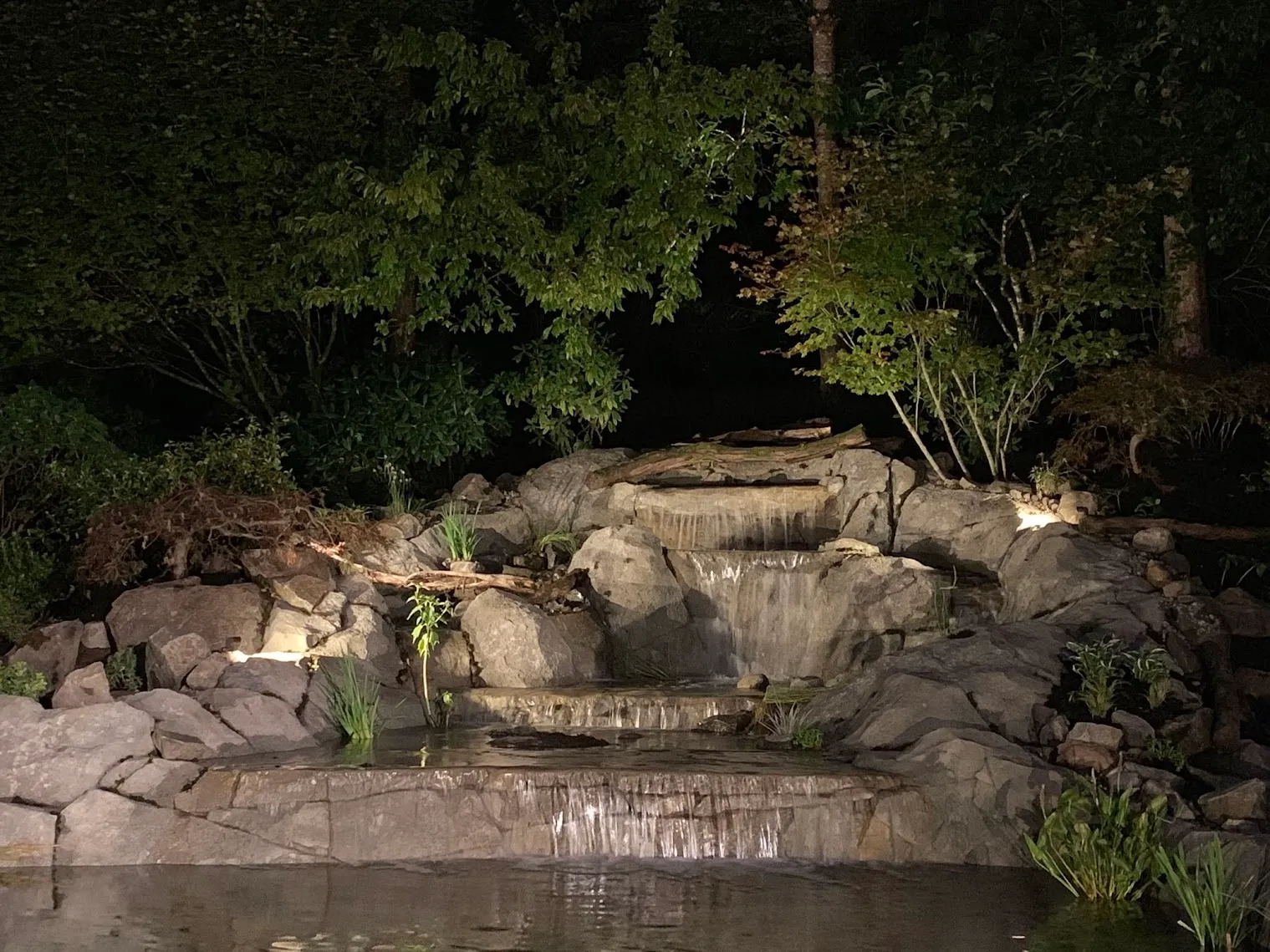
When you’re ready for something that lasts and truly looks designed, that’s the step up. It starts with quality fixtures — solid housings, sealed connections, and finishes in brass, copper, or good powder-coat that shrug off years of Oregon rain and freeze-thaw. It runs on properly sized wire and buried, weather-rated connections, so the last light is as bright as the first. And it’s placed by an experienced eye that can already picture the finished scene after dark — the glow on the stonework, the wash across the lawn, the shadow play through a tree — a picture most people can’t quite see in advance. That’s what the investment really buys: materials that last, and the experience to make them beautiful.
What you get back
There’s a warmth to it that’s hard to put a price on. A home that glows a soft welcome as you come up the walk, instead of looming as a dark shape. A patio you can still linger on with a blanket and a bowl of soup on a cool October evening. Kids finding the front door without a stumble, and guests saying oh, this is lovely before they’ve even reached it. Good light is how a place stops feeling closed for the season and starts feeling like somewhere you want to be — even in the dark half of the year.
- Practical: sure footing on your steps and a findable front door through the darkest months.
- Emotional: your yard becomes somewhere you actually see and use after dark, and your home glows a quiet welcome instead of sitting there as a black void — a place you’re glad to come home to.
- Financial: an honest investment that reveals the stonework, water feature, and plantings you already paid for, so your curb appeal works a second shift after sunset.
When to call us
Low-voltage lighting isn’t a separate service we advertise — it’s part of how we design and build a landscape, and it’s one of the things we check during a pond cleanout. That design work is where the value lives: a real day’s craft, and worth what it costs.
We design and build landscapes — lighting included — across the north Willamette Valley, from Woodburn up to Lake Oswego and Newberg over to Oregon City. You can see more of our work in the photo album. When you’re ready to talk, request an estimate or call (503) 678-7744 — the on-site look is free.